Gatien Ricotier
CTO · Building AI tools for medical laboratories · Researcher in history of mathematics
Strasbourg, France
I am the CTO at B2A Innovation, the R&D subsidiary of the medical laboratory group B2A, and a researcher in history of mathematics. Two activities that look distant — until you notice they share the same core question: how is knowledge constructed, validated, and spread?
In the lab, I build machine learning tools for medical diagnosis, design health data infrastructure, and co-develop digital health projects at events like Hacking Health Camp. In archives, I study how Bourbaki collectively rewrote the standards of mathematics — one of the most ambitious knowledge-construction projects of the 20th century. Both sides sharpen the other: the historian's eye for how communities build consensus is useful when pushing a new algorithm into clinical practice; the data scientist's instinct for patterns is useful when navigating decades of handwritten notebooks.
Feel free to reach out for any discussion, feedback, or collaboration.
I have not, of course, created this web page without any help. Thanks to David Miller for sharing his templates under the Open Source MIT license.
Last update: April 2026.
Data science
Making sense of data
At B2A Innovation, data is never an end in itself — it is the material from which better diagnostics are carved. I build machine learning pipelines on laboratory data (serum protein electrophoresis, bacteriology, hematology), design health data infrastructure, and navigate the regulatory constraints that turn a promising algorithm into a validated medical device. The same instinct — finding signal in noise, tracing the logic behind a pattern — also drives my work in historical archives, where the data is handwritten and the "database" has not been indexed for a century.
Building tools that change practice
A result that stays in a notebook changes nothing. What matters is whether the tool reaches the person who needs it — the clinician, the patient, the researcher. This means interactive dashboards, validated software, and products developed collaboratively with the people who will use them. It also means understanding how knowledge becomes practice, which is precisely what the history of mathematics teaches: Bourbaki did not just prove theorems, they redesigned how an entire discipline was taught and transmitted. That tension between innovation and institutionalization is one I navigate every day.
Health Innovation
B2A Innovation
B2A Innovation was founded by young biologists from B2A and reinforced by expertise in applied mathematics. The team covers the full value chain: laboratory optimization, scientific and technical expertise, sample and data valorization through a certified biobank, and clinical research. My role spans machine learning for diagnostic algorithms (including serum protein electrophoresis classification), health data infrastructure, and the regulatory pathway (IVDR) for medical AI devices.
SynthéSanté
SynthéSanté delivers a curated, personalized medical watch directly by email. Users describe their professional context in plain language; the service synthesizes the relevant scientific publications and health news at the frequency they choose. The proof of concept was developed at Hacking Health Camp 2025.
NutriSuivi
NutriSuivi is a mobile application for nutritional follow-up based on meal photography, designed for patients with chronic kidney disease or those managed for cardiovascular risk. Patients photograph their meals; the app estimates nutritional intake and facilitates communication with their healthcare team. The proof of concept was developed at Hacking Health Camp 2025.
S'installer en Santé
S'installer en Santé is a job listing and matchmaking platform for healthcare professionals, designed specifically to address medical desertification. Unlike generic job boards, it factors in the personal, professional, and demographic constraints of both practitioners and territories — helping match the right professional with the communities that genuinely need them. The project received two awards at Hacking Health Camp 2026: the Prix du Syndicat des Médecins Libéraux and the Prix de la French Tech Est.
History of mathematics
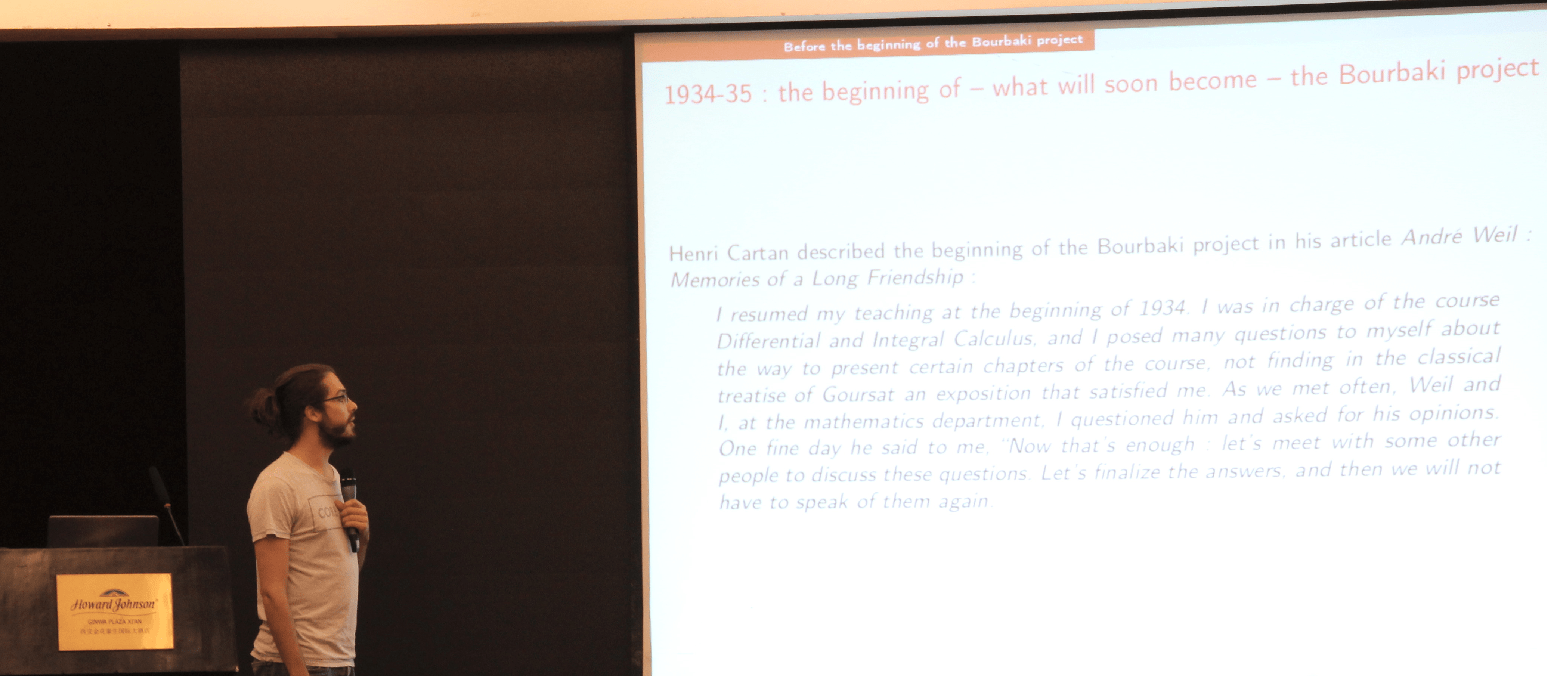
During a winter school in mathematics in 2016, I realised I was more interested in how mathematical knowledge is constructed and spread than in proving new theorems. That question led me to Bourbaki — a collective that spent decades rewriting the foundations of mathematics and, in doing so, became one of the most striking examples of open collaboration in the history of science. I completed a PhD on this collective at the University of Strasbourg and have kept working on related questions since.
The parallel with my data work is not coincidental. Building a validated diagnostic algorithm in a medical laboratory is, structurally, not so different from building a shared mathematical treatise: you need to agree on definitions, manage disagreement inside a team, convince an external community, and navigate the gap between what is technically elegant and what is institutionally acceptable. The historian's perspective makes the data scientist more lucid about what "validation" actually means.
Open collaboration, then and now
Bourbaki, mailing lists, Wikipedia, open source software, Stack Overflow, Hacking Health hackathons — all are attempts to produce shared knowledge under collective authorship. My research focuses on what drives people to contribute, how communities absorb or resist external pressures, and what happens when a collaborative project becomes a standard. The health innovation projects I contribute to are, in this sense, living case studies of the same dynamics I study in archives.
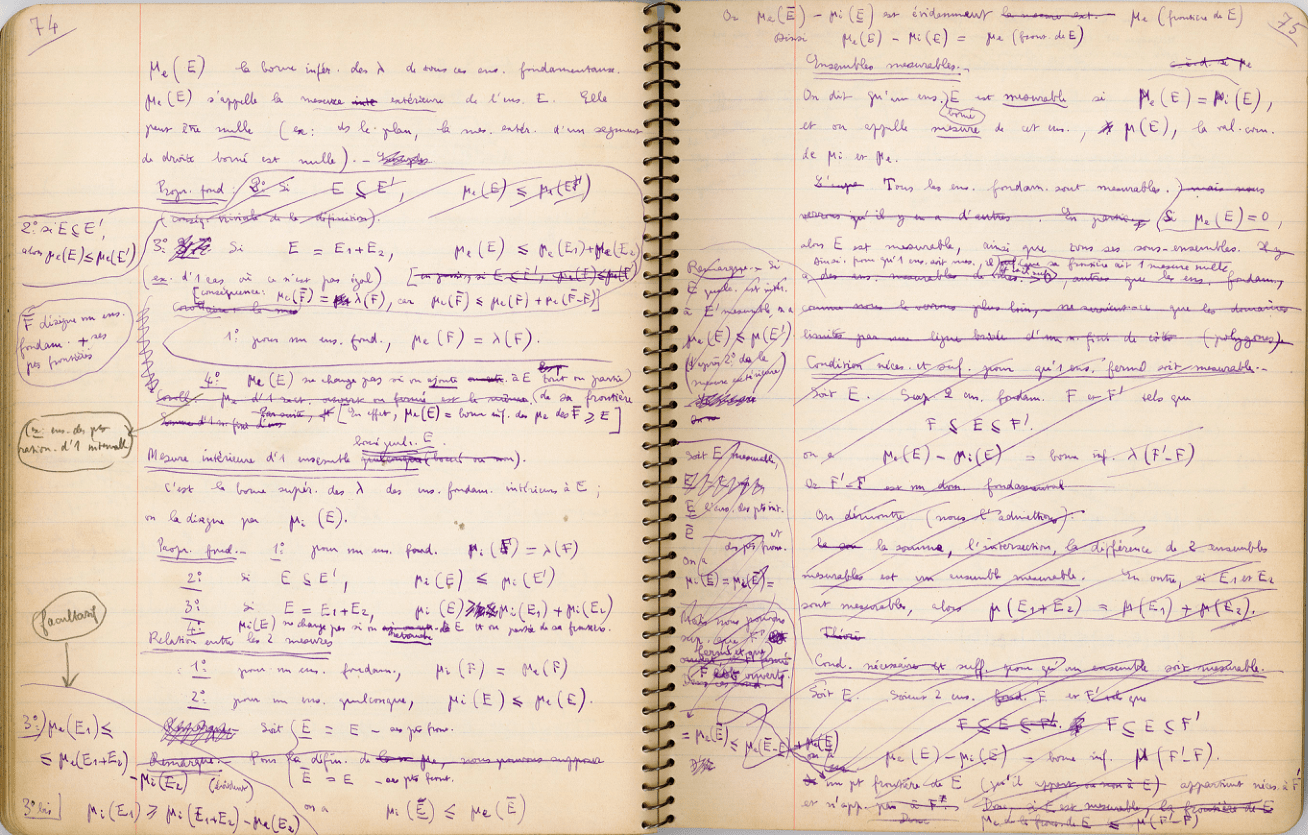
Henri Cartan's drafts
Henri Cartan's children gave their father's drafts, mainly notebooks, at IRMA's library in 2009. Michèle Audin ordered them in 2014 and made an inventory which is available here. I took advantage of living in Strasbourg to work on these notebooks. Do not hesitate to ask for information or a few scans.
One of the main reasons for working on this archive comes from the fact that the first meetings of the Bourbaki's group have been described as a consequence of the - loads of - questions from Henri Cartan to André Weil about his calculus' teaching. The evolutions of his lessons on general mathematics, calculus or algebraic topology are quite impressive.
Academic positions in France during the XXth Century
After my research in academic archives for my PhD, I do have now an interesting material to track the positions of academics in France : the "Tableaux de classement du personnel enseignant et scientifique". I'm starting (yes Pierre, I will do it one day) to extract the data in them in order to build a website for tracking the positions of individuals and the individuals in a specific position.
Publications & talks
The two threads of my work — understanding how knowledge is built in mathematics, and building tools that change medical practice — produce different kinds of outputs, but the same underlying question runs through all of them: how does a result become trusted? How does a community agree on what counts as valid? The items below are organized by context, not by type.
History of mathematics
Securing an academic position in France during the interwar period: was it better back then?
A l’origine de Bourbaki : l’évolution de l’enseignement du calcul différentiel et intégral d’Henri Cartan entre 1931 et 1940
Bourbaki, ordinary singularities and a singular collective
Maurice Fréchet — Les mathématiques et le concret
Projets collectifs et personnels autour de Bourbaki dans les années 1930 à 1950
Jean Leray et Bourbaki : exemple d’une lutte de pouvoir sur fond d’avancement de carrière à la fin des années 1930
Medical biology & data science
The same question that runs through the history work — how does a result become a standard? — is live here too. Each of these contributions is a step toward making a piece of analysis usable, reproducible, and trusted in clinical practice.
Development and Validation of a Protein Electrophoresis Classification Algorithm: Tabular Data-Based Alternative
Correction de la kaliémie en fonction de la température et du délai pré-analytique
Etude de la prédictibilité de la résistance des Enterobacterales aux quinolones en fonction de la CMI de l’ofloxacine
Hépatite E : plus-value du biologiste dans une pathologie sous diagnostiquée
Etude de la cinétique de la propagation des variants du COVID-19
Talks in history of mathematics
Selected invited talks and conference presentations. The recurring thread is the question of how mathematical writing, teaching, and collective organization shape what counts as rigorous — a question that rhymes, in the present day, with how a clinical algorithm earns the trust of its users.